
Lobular module
Recapitulates key features of the liver lobule by organizing hepatocyte, endothelial, stellate, Kupffer, and cholangiocyte-associated elements to support local function and cell-cell crosstalk.
Technology
Engineering tissue systems that better
reflect how cells behave in vivo
At Allele Biotechnology, Tissue Mimetics is our approach to building physiologically informed, multicellular tissue systems that better reflect the organization, signaling, and cell-cell interactions found in native tissues.
By combining iPSC-derived parenchymal, stromal, vascular, and immune-relevant cell types in structured co-culture formats, we create tissue models that better support maturation, function, and translational testing.
Our first application is liver, where interactions among hepatocytes, cholangiocytes, endothelial cells, stellate cells, Kupffer cells, and stromal compartments are essential to tissue function.
Allele’s liver Tissue Mimetics platform supports multicellular liver tissue formats for co-culture development, biological validation, preclinical applications, and drug screening as a NAM.
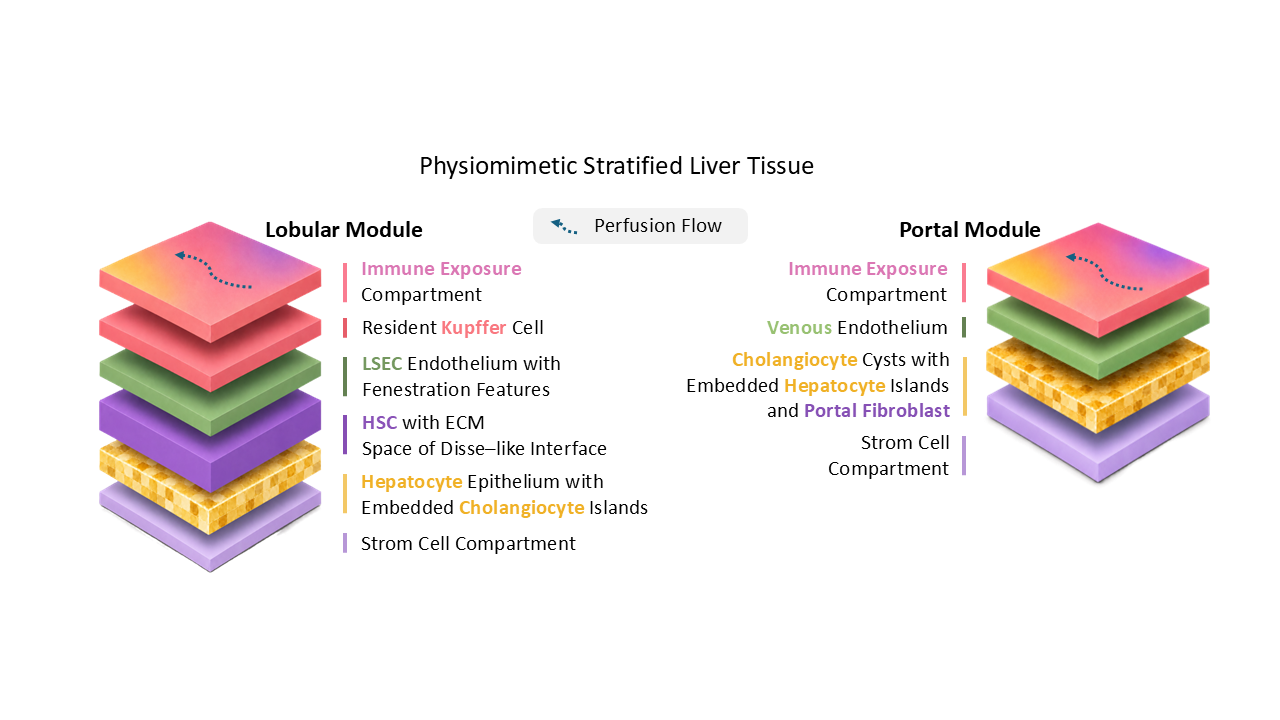
Recapitulates key features of the liver lobule by organizing hepatocyte, endothelial, stellate, Kupffer, and cholangiocyte-associated elements to support local function and cell-cell crosstalk.
Models the portal-area niche using cholangiocyte cysts, embedded hepatocyte islands, portal fibroblast-like support, vascular endothelium, and stromal organization within an engineered tissue system.
Human tissues are shaped by organized cellular neighborhoods, matrix cues, soluble factors, perfusion, and immune exposure. Conventional monoculture systems often fail to capture this biology, limiting long-term function and tissue-level predictivity. Tissue Mimetics was developed to address this gap.
Integrates iPSC-derived parenchymal, stromal, vascular, and immune-relevant cell types.
Spatially organized modules that recreate tissue-like relationships and interfaces.
Designed for flow and scalable culture to support function and maturation.
Includes resident and recruited immune cells to model physiological immune responses.
Enables applications in drug screening, disease modeling, and regenerative medicine.
Tissue Mimetics is enabled by Allele’s broader capabilities in iPSC generation, directed differentiation, genome engineering, mRNA technology, and GMP cell manufacturing.
By combining these capabilities with organ-specific tissue design, Allele is building a practical and scalable platform that connects stem cell biology with translational tissue engineering to create more contextual, biologically relevant human tissue systems.
Allele’s Tissue Mimetic platform supports the development of biologically, physiologically, and genetically relevant tissue models across liver, immune, and regenerative medicine applications.
To learn more about our liver co-culture systems, iPSC-derived cell types, or organ-specific tissue engineering programs, contact Allele Biotechnology.